Thursday, March 19, 2015

NarvikRando- a track setter's perspective.

The inaugural Narvik Rando went down this past Saturday, with about 55 skiers (31 in the race category/ 24 in the tourist category) toeing the line. From most accounts it seems like everyone had a pretty good time and are psyched to return next year.

The whole event has been many months in the planning, with Micke at the head of a troupe of volunteers (myself included). Plenty of meetings, lengthy online discussions and countless hours went it to the whole thing and it was a relief that it all went roughly according to plan.

I was responsible for setting the track (but got a LOT of help from Andreas, Micke, Jon and Mike) which was necessarily carried out pretty much at the last minute. A few days of very stiff winds (gale force above tree line the day before) followed by a night of heavy precip (which came as rain below tree line) created some real challenges and forced some changes in the course even in the last few hours leading up to the race.

I’m not making excuses, and the following is really just a record/call for comments to draw on in the future in order to make next year’s race even better.
  • Flags. A ski mountaineering race like this (1650metres of vert.) eats up a LOT of course marking flags. Next year we need about 2x the number we had this year. Or better yet 3x as many. I think composite sticks would be more durable than bamboo sticks like we had this year, but maybe a bit more expensive.
  • Hi-viz spray paint works well when you don’t have enough flags. But they are certainly no replacement as it gets covered by windblown snow and isn’t visible as something poking above the skyline.
  •  Skins tracks should be mellow and bootpacks should have steps that even short people can comfortable manage. I feel like this aspect was done okay, but a few sections of the skinner were on wind scoured slopes and the booter had some sugary sections which made it tricky to maintain much consistency.
  • Transition zones ought to be on flat terrain. The skin to boot transition this year was all off-kilter (because I didn’t have time to shovel it level).
  •  Track setting (at a reasonable standard) is a bigger job than I had anticipated. Ideally an even bigger crew should be involved and an even earlier start is probably wise.
  •  Last minute changes to the course (due to weather/avalanche hazard/ surface conditions etc.) are stressful and create a shit load of extra work. Having a course which can be skied in any sort of weather/snowpack would likely mean that the course is not sufficiently challenging, so a certain degree of flexibility is of course necessary. However having a very firm plan at least two days before the race starts will ensure a lot more efficiency in setting the track and lead to it being of a higher quality.


All things considered I think it went pretty well and I’m psyched for next year and making the event even better. I didn’t get a chance to take any photos during the competition. But there are some photos and reports in Norwegian from FriFlyt here and from Kondis here.


Below are a couple photos from some other outings this past week, ‘cause a blogpost without photos ain’t much apparently.

Lapping the backside of Linken with Damien and Sarah from Schweiz

Mike's first ever skin to Tredjetoppen

Mike scoping lines from 3de.

Some decent turns on solar aspects earlier this week- this is in one of the 5 fingers.

Sunday, March 8, 2015

Beisfjordtøtta Glacier

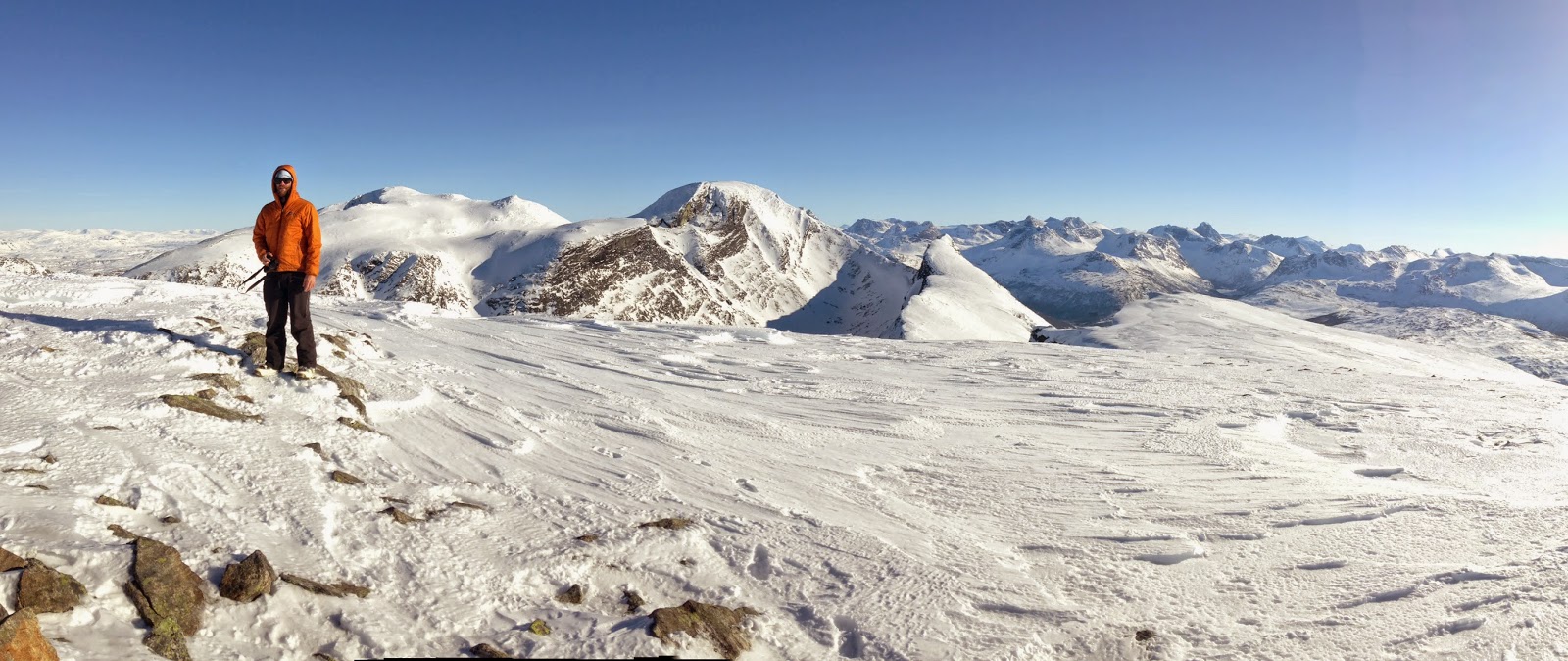
Earlier in the week Micke mentioned a new line on Beisfjordtøtta he was keen to check out. With a decent weather forecast and work not starting until the afternoon we decided to go for it on Thursday. Skinning up from the base of the ski hill we did a bit more reconnaissance for the upcoming Narvik Rando which will be happening next weekend. If the weather cooperates this course promises to be the best, most scenic and memorable ski mountaineering event in Norway- if you haven't signed up already it isn't too late. Around treeline we were joined by Einar and continued up along the course route to Tredjetoppen.

Typical views from the Narvik sidecountry. Photo: Einar
Enroute to Tredjetoppen with some of the driving forces behind NarvikRando
From Tredjetoppen we skied the usual line, wrapping around the cliff bands at 1000m. before skinning back up to the Forsnes ramp. The normal line down to Forsnesvatnet skied beautifully like it usually does. Then we skinned up to the saddle between Jøden and Beisfjordtøtta, followed by a short bootpack along the rimed up ridge line until we reached a notch in the ridge where Micke's idea awaited. 

Micke skiing from 3de toppen

Skinning up to the Forsnes ramp with Sovende Dronning in the background

Micke dropping in on the Forsnes ramp


Einar making his way down the Forsnes ramp

Micke slaying the Forsnes ramp

Einar booting up the rimey ridge line


 The entrance to the line was guarded by a small cornice, which made viewing the couloir below kind of tricky- Micke made short work of tidying it up with shovel whilst tied in. After a steep rollover in the entrance around 45, the couloir mellowed a little to around 40 and offered some fun turns with a double fall line. Once down on the glacier the slope angle eased up and offered some fun, cruisy turns straight down the fall line. Below this another couloir, in the realm of 30-35 was skied to exit the glacier. From here some traversing and a bit of bushwhacking took us down to the road near Beisfjord. In total the final descent involved about 1400 metres of vertical, varied in the sort of skiing it offered up but also somewhat consistent and sustained in the attention it captured. Like any really good line, once it has been skied, it seems totally obvious and I was left wondering why it wasn't skied regularly.

Sizing up the entrance couloir. Photo: Micke

Einar skiing the entrance couloir.

Fun pow turns on the glacier sandwiched in between two nice couloirs


Micke in the exit couloir

Einar and myself skiing the exit couloir. Photo: Micke

Whilst skiing through the trees on the way down I saw a wolverine!
He bolted uphill. These are his tracks.

Walking the last hundred metres to the road.

Down at the road we were a little late for the bus we had planned on catching, but instead of waiting for the next one happily got a lift back to town from one of Einar's work buddies. 

This was all before work and all accessible without a car. After years in Narvik I am still amazed by the proximity of great ski lines and the fact that there are still so many "un-skied classics" like this one waiting to be discovered.

Wednesday, March 4, 2015

Rånkeipen and some unsolicited advice on ski crampons

I've had a little unplanned hiatus from the blogosphere on account of being busy with other stuff and not having much to report on. We're entering the prime season here in Norway though so I think its about time I pulled my finger out and started posting again.

Today invovled a sterling outing on Rånkeipen with Markus, Magnus and Axxa. I'll let the pictures speak for themselves. Suffice to say it was very fun.

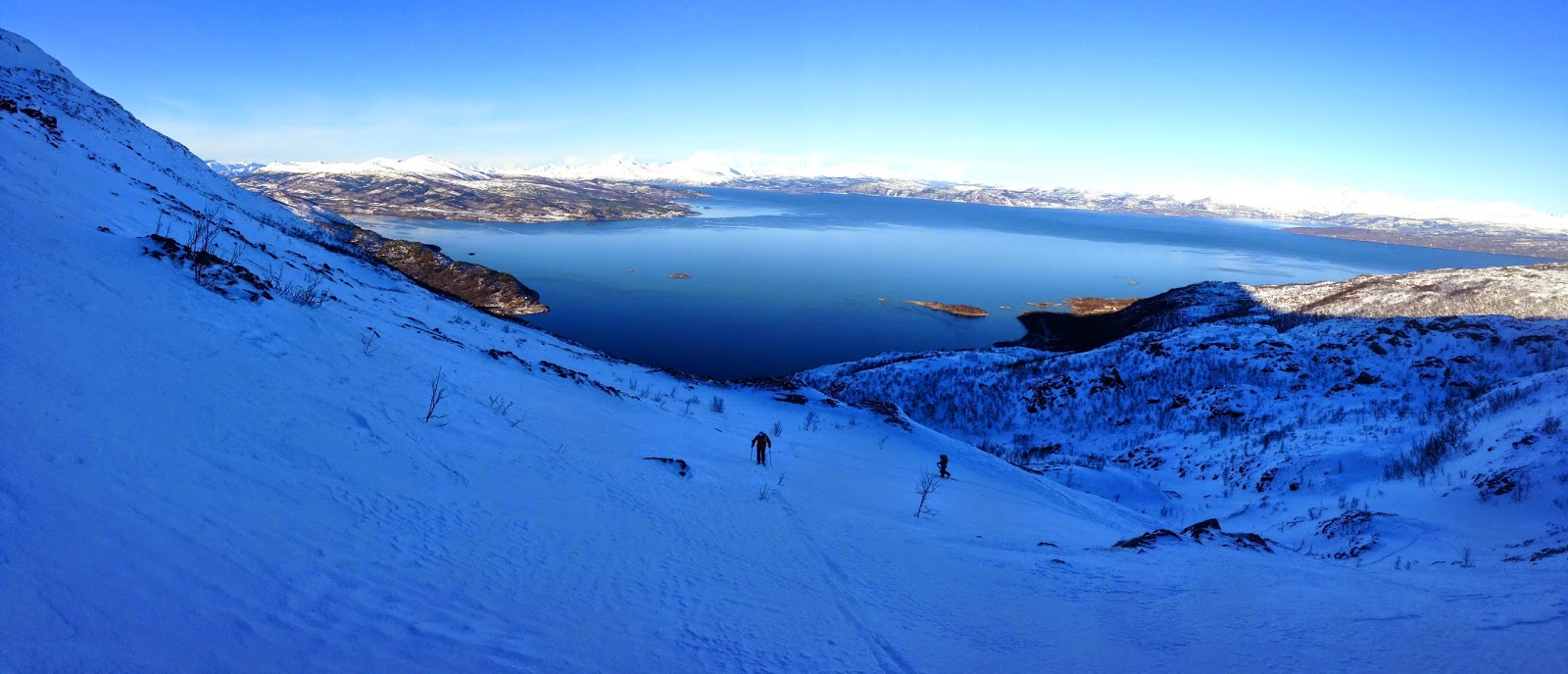
Once we cleared the dense birch trees the views over Ofotfjorden were totally OK

Axxa has a red speed suit. She is also one of the most enthusiastic and speediest touring partners I've ever had.


Looking South

Looking North

Magnus and Axxa approaching the summit of Rånkeipen

Axxa covered about 2x the vert that the rest of us did.

As usual the summit pitch was rimed up and kind of wind jacked. And as usual the views were pretty decent.

The skiing was mostly dust on crust. But this is better than simply crust

Magnus and Axxa on the cruisy lower section

Markus and Ofotfjorden

Markus and Rånkeipen


And now for some unsolicted advice on ski crampons
One of the fantastic things about all the wind jacked snow in northern Norway is the great value for money we get for our ski crampons. Despite how regularly I feel like I use them I am constantly surprised by the number of people who don’t own a pair or don’t know how to fit them to their skis effectively. So I decided to share a little unsolicited instructional rant.

First off, get some. If you ever bring an ice axe and crampons on your outings in the alpine, then you will also benefit from having some ski crampons.

I have seen some weird techniques for fitting/removing ski crampons. Some people even go so far as to remove their boot from the binding to fit the ski-crampon, this is unnecessary and just as ridiculous as taking your ski off to rip your skins.

Like any decision in ski mountaineering, the choice to fit or remove your ski crampons is all about anticipation. Look ahead, think about the snow surface and slope angle. It’ll be much easier to fit on a small ledge in softer snow than on some steep boiler plate.

If I’m expecting to use ski crampons I have them hanging on a small toy carabiner from my pack somewhere easily accessible, not inside my pack. They make a nice jangling noise like chimes and mean you can put them on in a jiffy without having to take your pack off.

Step 1) Unclip your ski crampons one at a time.

Step 2) If you are fitting the ski crampon to your left ski, hold the ski crampon in your right hand and 
plant your left pole solidly in the snow/ice to help balance.

Step 3) Stand on your right ski and lift your left ski up, swing it around behind your right leg.

Step 4) Bend over and slot the ski crampon into position.

Step 5) Repeat the process for the other ski.

Below is a little demonstrational  video


Ski Crampons- how to put them on better from Kaj Sønnichsen on Vimeo.

Thursday, November 13, 2014

Running in Australia

Just finished up a two weeks visit back in Australia, aside from catching up with family and drinking a lot of coffee and beer, I was keen to get some training done. In particular I was eager to log some vertical in preparation for the upcoming winter of touring and also to revisit some of the mountains in the SE corner of Australia which were such an integral part of my upbringing.

Over the years I’ve found that most people (Australians included) are oblivious to the mountains of Australia, thinking that beyond the picturesque beaches lies a flat and arid interior. Whilst it is true that the climate in Australia is arid, the idea that it is all flat isn’t quite accurate. The area in the SE of Australia, including the Snowy Mountains (something of a misnomer) and the Victorian Alps comprise dozens of peaks with a respectable relief from the nearby valleys. True, mountain terrain is mostly quite gentle and benign with rounded “hills” rather than jagged spired dominating the skyline; and true, the snowline is usually quite high, but if you are keen there is some great trail running and some interesting ski touring to be had.

I enjoyed four standout trail runs while I was in the country:

Mt Bogong, up and down the Staircase (about 16km and 1450+ metres, 2:20)

The highest point in Victoria, and one of the first mountains I hiked up as a kid. I have many memories of this peak, such as sleeping on the summit without any water as a teenager on a summer hike over from Hotham, and on another occasion teaching myself how to self-arrest with an exceptionally long, old axe borrowed from a friend.

The run was nice, however I discovered that I’ve spent enough time out of Australia in the past years to have grown unaccustomed to reptiles and had a few frights encountering half a dozen blue tongued lizards which I instinctually thought to be snakes.


Mt Buffalo, up the Big Walk (about 11km and 1050+ metres, 1:30)

This was the first place I ever went skiing at the age of 5. Good to see it again.
Earlier this year this place hosted Australia's first ever event in the SkyRunning series.


Mt Feathertop, up the Bungalow Spur and along the Razorback Ridge (about 22km and 1700+ metres, 2:55)

The nicest mountain trail in Australia in my opinion; a perfect balance between being runnable and also steep sections which require more effort. Not much in the way of views whilst I was there though:


Mt Kozciusko and the Main Range Track from Thredbo (about 44km and 1800+ metres, 5:02)


I used to think that the Main Range track was the best trail in the Australian Alps, and it certainly does have some terrific views over the highest peaks in Australia. The trail has received an immense amount of upkeep in the past decade, to the point where a quad bike could now comfortably traverse most of the track. After a winter with heavy snowfall there was still quite a bit of it around for early November, I even saw one fellow skiing on Carruthers Peak


Thursday, September 18, 2014

Running Waikaremoana

I was meaning on getting over to Te Urewera to run around the famed Lake Waikaremoana last winter but with the logistical hassle of the car shuttle my focus always shifted to other trails closer by which were simpler to access. With Thor visiting and stormy weather forecast for the central plateau, I figured it was high time to finally check it out.

A 6:30am departure from Natty P saw us get to Murupara before 9am where our hopes of buying some electrolyte mix from the supermarket (quite ridiculous in hindsight) morphed into settling for a few packets of tropicana RARO. We hit the road again and with only 100km left to drive figured that we would be running by around 11am, however the winding, gravel road soon slowed us down and we kept recalculating our start time. By the time we stashed a few bags with clothes and some food at a lodge at the end and drove back to the northern start, it was past 1pm and it was obvious that we'd be finishing in the dark.


Lake Waikaremoana track, stolen from here
Undeterred we set out from the Hopuruahine end hoping to make up some time on the early section of the track which sounded relatively flat and simple. The trails was indeed pretty flat but this was balanced out by how muddy it was from some heavy rainfall a few days earlier. Before long our shoes and legs were caked in a thick layer of mud.


It started out muddy...

But got drier as we got deeper into the forest.


After the initial flat kms trail was gently undulating and for the most part gentle enough to run.

All the streams and rivers have cool suspension bridges, which are much harder to run on than they look.
The miles rolled by with sweet singletrack, constantly undulating through dense podocarp forest. Every so often the track would be near enough to the lake edge to offer up some terrific views over the lake, but for the most part it felt like we were running in the middle of some ancient forest in the middle of nowhere.


Did I mention it was muddy?
After 5 hours on the move we reached the Panekire hut at dusk, and with only 8.5 km of downhill left were pretty much on pace to be finished in a little over 6 hours. However with the darkness came the rain and mist, and our descent down the technical and rooty trail slowed to walking pace. Even with decent headlamps we struggled to see more than a few metres through the dense fog and sideways rain, we forgot all about our hopes of coming in under a certain time and focussed instead on not falling and twisting an ankle on the rugged trail.

We got a few glimpses of the lake from the Panekire bluff just before the sun set and the rain settled in.


Wet and cold, but stoked after 50km of stellar trails
In the end we ended up reaching the end of the trail exactly 7:00 after setting out. Soaked to the bone and a little cold we were then rewarded with a bonus 4 km to get back to the self contained unit we'd rented for the night, at 8:50pm we finally got our shoes off and warmed up with some hot soup and cold beer.

The Panekire bluff seen from the road, on the drive home the next day.
It is an amazing trail and one which ought to get run a lot more often. For next time there are a few things I'd change:
  1. By travelling in the opposite direction you'd get the major climb done on fresh legs, and would have a much more runnable descent.
  2. Start earlier in the day.
  3. Do it at least a few days since the most recent rain, to ensure a little less mud.